Startup Originals Team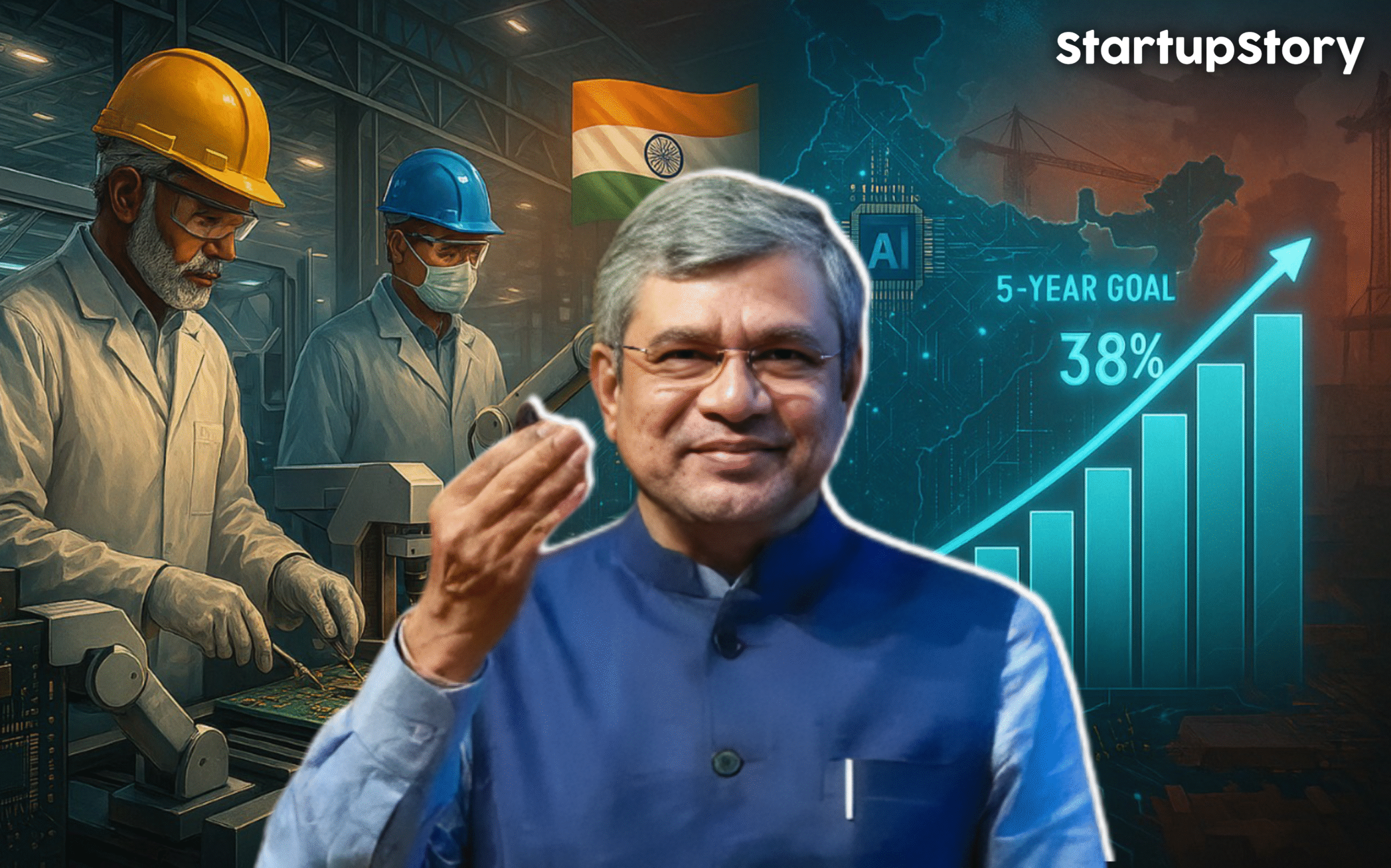
Union Minister Ashwini Vaishnaw has outlined India’s ambitious roadmap to scale its electronics manufacturing ecosystem. In a recent ET roundtable, he emphasized India’s goal to boost domestic value‑addition in electronics to 38% in five years, matching China’s current level.
Strong Momentum: Value‑Add Growth:
- Current status: India has already surpassed a 20% value‑addition mark within six to seven years.
- Near‑term goal: Cross 30% value‑add in the next two to three years.
- Long‑term vision: Reach 38%, which aligns with China’s present benchmark, in five years.
De‑risking From China: A Methodical Path.
China is currently the global leader in electronics value‑add (~38%). Vaishnaw notes that India’s strategy is a “methodical and sustained” build‑up – focusing on local skill development and diversified supply chains.
A trigger for urgency was Foxconn’s recent repatriation of over 300 Chinese engineers from its Indian plants-reportedly due to Chinese government restrictions. This highlights risks tied to geopolitical dynamics and underscores the need for indigenous capabilities.
Global Partners Enter the Ecosystem:
To reduce dependence on Chinese personnel, India is collaborating with Taiwan, the U.S., and South Korea, alongside training its own engineers .
Such a multi‑national approach supports the plan to cultivate an ecosystem capable of competing with China on both scale and innovation.
Government Initiatives Fueling Growth:
- India Semiconductor Mission: ₹76,000 crore to rapidly expand chip‑making capabilities.
- Components Incentive Programme: ₹23,000 crore to support a domestic supply chain.
- Recent Push: The cabinet approved ₹229 billion (~$2.68 billion) to boost electronics components production-creating around 92,000 jobs.
Key Projects Driving Momentum:
- Tata Electronics, Assam: A chip‑assembly plant serving global telecom firms.
- Micron, Gujarat: A memory chip manufacturing facility being set up.
- CG Power, Gujarat: A power‑electronics plant to reinforce upstream capabilities.
The Bigger Picture:
India’s electronics manufacturing sector is currently valued at $145 billion, expanding at a 20% CAGR.
Some analysts expect margins to tighten as incentives like PLIs begin phasing out – but government schemes like the ECMS aim to maintain value‑add growth from ~20% to 30–38% in five years.
Self‑Reliance: A Strategic Imperative:
Vaishnaw stresses that to stay resilient against geopolitical shocks, India must build in‑house manufacturing of “every machine, every component”, not just assembly. This self‑reliance mindset underpins the electronics mission.