Startup Originals Team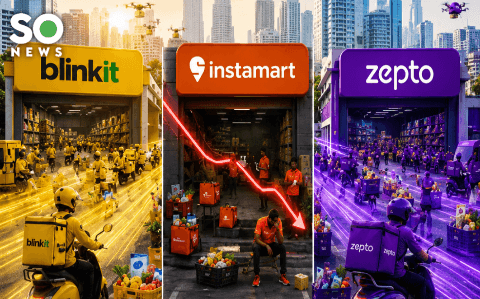
The battle for dominance in India’s quick commerce market is intensifying, and Swiggy-owned Instamart appears to be losing momentum. Recent industry data indicates that Instamart’s market share has declined from 34% to 21%, highlighting the growing competition from rivals that have been expanding faster and capturing a larger share of new customer orders.
While Instamart continues to grow in absolute order volumes, competitors have been adding customers and orders at a significantly quicker pace.
Rivals Capture Most of the Industry Growth
India’s quick commerce sector has become one of the fastest-growing segments in the country’s startup ecosystem. As demand for 10–20 minute deliveries rises, companies are investing heavily in dark stores, logistics infrastructure, and customer acquisition.
Over the past two years, much of the industry’s incremental growth has been captured by competitors such as:
- Blinkit
- Zepto
Both companies have aggressively expanded their operations, helping them gain a larger share of new orders entering the market.
Why Instamart Is Losing Market Share
The decline in market share does not necessarily mean Instamart is shrinking. Instead, the overall quick commerce market is growing so rapidly that competitors are growing even faster.
Several factors have contributed to this shift:
- Rapid expansion by rivals: Blinkit and Zepto have significantly increased their dark store networks across major cities.
- Higher customer acquisition spending: Competitors have invested heavily in discounts, marketing campaigns, and user acquisition.
- Wider product assortment: Quick commerce platforms are moving beyond groceries into categories such as electronics, beauty products, medicines, and general merchandise.
- Operational efficiency: Faster delivery times and improved inventory management have become major competitive advantages.
As a result, rivals have managed to capture a larger portion of new consumer demand.
India’s Quick Commerce Market Continues to Explode
Despite increasing competition, the broader industry remains on a strong growth trajectory.
Quick commerce has evolved from a convenience service into a mainstream shopping habit for urban consumers. Customers increasingly rely on these platforms for:
- Daily groceries
- Household essentials
- Electronics accessories
- Personal care products
- Snacks and beverages
The combination of convenience, speed, and increasing product availability continues to drive adoption across Indian cities.
Pressure on Profitability and Growth
The race for market leadership is forcing companies to spend heavily on:
- Logistics infrastructure
- Dark store expansion
- Customer acquisition
- Delivery operations
While order volumes are growing rapidly, companies must balance growth with profitability. Investors are increasingly watching whether quick commerce firms can achieve sustainable margins while maintaining expansion.
For Instamart, the challenge will be protecting its customer base while accelerating growth in a market where competition is becoming more intense every quarter.
The Bigger Picture
India’s quick commerce industry is increasingly becoming a three-player race dominated by:
- Blinkit
- Zepto
- Instamart
As these companies compete for market share, consumers are benefiting from:
- Faster deliveries
- Better service quality
- Wider product selection
- Competitive pricing
The next phase of competition is likely to focus not just on speed, but also on profitability, customer retention, and expansion into new product categories.
Conclusion
Instamart’s decline in market share from 34% to 21% highlights the rapidly changing dynamics of India’s quick commerce sector. While the platform continues to grow, rivals like Blinkit and Zepto are capturing a larger share of industry expansion. As competition intensifies, the battle for leadership in India’s quick commerce market is expected to become even more aggressive in the coming years.