Startup Originals Team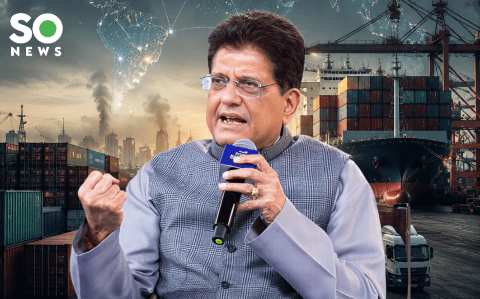
Union Commerce and Industry Minister Piyush Goyal has called on Indian businesses to strengthen domestic industry and reduce dependence on overseas suppliers, saying the current geopolitical climate demands a shift away from “business as usual.” His remarks come at a time of rising global tensions linked to the US-Iran conflict and increasing uncertainty in global trade and supply chains.
According to Goyal, India must use the current global environment as an opportunity to build stronger economic resilience and reinforce local manufacturing capabilities.
Global Tensions Reshaping Trade and Supply Chains
Speaking on the changing global landscape, Goyal highlighted how geopolitical and economic disruptions are affecting international trade systems. Ongoing conflicts and uncertainty are forcing countries and businesses to rethink supply chain strategies and reduce overdependence on foreign markets.
He stressed that:
- Domestic manufacturing has become strategically important
- Countries need stronger internal economic systems
- Supply chain resilience is now a national priority
The minister said Indian companies should work collectively to strengthen local industries rather than relying excessively on imports and overseas suppliers.
India’s Economic Position Remains Strong
Despite global uncertainty, Goyal pointed out that India remains in a comparatively strong economic position.
He noted that:
- India recorded total exports of around $863 billion, marking a milestone year
- The country’s foreign exchange reserves are sufficient to cover nearly 11 months of imports
According to international benchmarks, including IMF standards, this places India in a stable position compared to many economies facing external pressures.
Push for Self-Reliance and Local Manufacturing
The minister’s comments align with India’s broader push toward:
- Self-reliance in key industries
- Expansion of domestic manufacturing
- Stronger trade resilience
- Long-term economic stability
Government initiatives such as “Make in India” and production-linked incentive (PLI) schemes are already focused on building local manufacturing ecosystems in sectors like electronics, semiconductors, defence, and renewable energy.
Goyal’s message reinforces the idea that global uncertainty can become an opportunity for India to strengthen its industrial base.
Why This Matters for Businesses
For Indian companies, the changing global environment could mean:
- Greater focus on local sourcing
- Diversification of supply chains
- Increased investment in domestic production
- Reduced exposure to international disruptions
Businesses that adapt early to these shifts may gain long-term strategic advantages as global trade patterns continue evolving.
The Bigger Picture
The statement reflects a larger global trend where countries are prioritising economic security alongside growth. Recent geopolitical conflicts, pandemic disruptions, and supply shortages have shown how vulnerable globalised supply chains can become during crises.
India is now positioning itself as:
- A resilient manufacturing destination
- A stable economic alternative in Asia
- A growing global trade and production hub
Conclusion
Piyush Goyal’s call for Indian businesses to prioritise domestic industry highlights the government’s growing emphasis on economic resilience and self-reliance. As geopolitical tensions reshape global trade, India is aiming to strengthen local manufacturing, reduce vulnerabilities, and build a more stable long-term economic foundation.