Startup Originals Team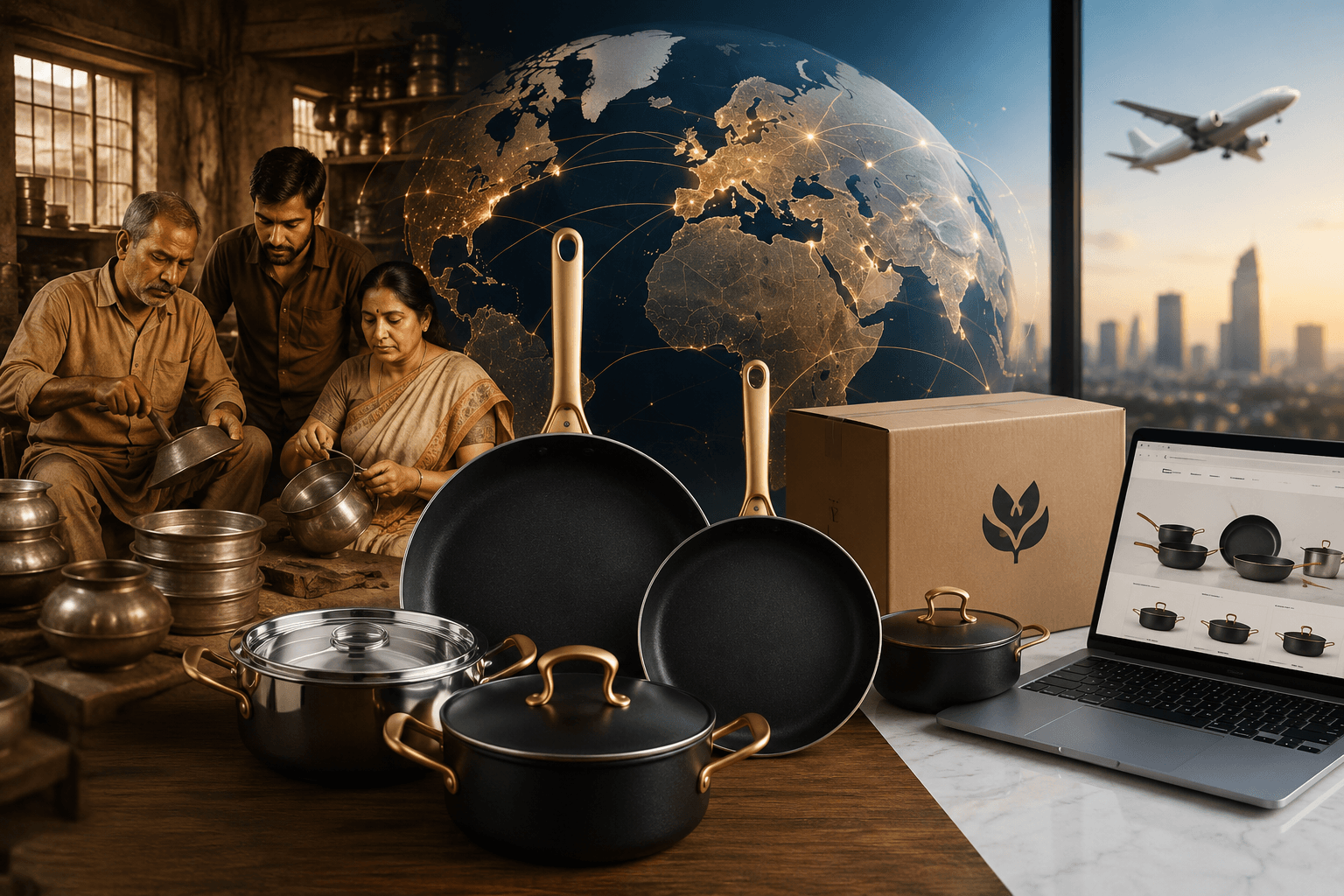
Not every startup success story begins with a large funding round or a technology breakthrough. Some businesses grow by taking a traditional industry, understanding changing customer behaviour and using digital platforms to reach a much larger market.
Nyra Kitchenware is one such example. Founded in Kanpur by Sushank Arora in 2020, the company grew from a family kitchenware business into a bootstrapped D2C brand selling traditional and modern kitchen products across India and international markets. The company says it has now crossed 1 million orders worldwide and offers more than 1,200 products.
The journey became particularly significant because Nyra was built during the COVID-19 pandemic, after Arora’s earlier IIT Kanpur-incubated startup had to shut down during the lockdown. Instead of treating the setback as the end of his entrepreneurial journey, he returned to his family’s kitchenware business and found a new opportunity.
The Beginning of Nyra Kitchenware
Arora came from a family with a multi-generational metalware business dating back to 1950. The family business gave him an understanding of kitchenware, suppliers and customer requirements, but the traditional business model had limited reach.
The COVID-19 lockdown changed the direction of his career. After his earlier startup was forced to close, Arora returned to the family shop in Kanpur.
While working there, he noticed that customers were increasingly interested in traditional cookware made from materials such as brass, copper and bronze, but many did not know how different metals should be used or maintained.
That observation became the foundation for Nyra.
How Nyra Kitchenware Found Its Opportunity
Instead of simply putting traditional utensils online, Nyra focused on helping customers understand the products.
The company built an education-led approach around traditional Indian cookware. Its content and product information aimed to explain the characteristics, uses and maintenance of different metals.
This helped Nyra address a problem that traditional kitchenware sellers often faced: customers knew the products existed, but many were uncertain about which products were suitable for particular purposes.
The company’s own positioning centres on combining traditional Indian metalware with modern design and clear product information. Its product range includes stainless steel, brass, copper, bronze or kansa, aluminium and iron cookware.
From a Family Shop to a D2C Business
The next major step was taking the family business online.
Nyra developed a digital-first model and began selling through its own D2C website as well as major e-commerce platforms. Its marketplace presence includes Amazon India, Flipkart, Myntra, JioMart and other platforms, while international sales are supported through global marketplaces and cross-border channels.
This approach allowed the company to move beyond the geographic limitations of its Kanpur base.
Rather than opening stores across India at the beginning, Nyra could use e-commerce infrastructure to reach consumers directly.
Its catalogue subsequently expanded to more than 1,200 products, covering traditional cookware, modern kitchenware and related categories.
Nyra Kitchenware Crosses 1 Million Orders
The scale of the business has become one of the strongest indicators of its growth.
Nyra says it has fulfilled more than 10 lakh, or 1 million, orders worldwide. The company continues to operate from Kanpur while serving customers in India and international markets.
Its international reach includes markets such as the United States, United Kingdom, Canada, UAE, Singapore, Japan and Australia. The company has also listed international marketplaces and platforms including Amazon Global and Noon among its sales channels.
For a company that originated from a family-run business in a Tier-2 city, reaching customers across multiple international markets represents a significant shift in scale.
The Decision to Stay Bootstrapped
Another important part of the Nyra Kitchenware success story is its funding journey.
Unlike many consumer startups that depend on venture capital to finance rapid expansion, Nyra has built its business as a bootstrapped company. Recent coverage describes the company as profitable and entirely bootstrapped.
This has meant that the company has had to focus heavily on its products, marketplace operations, customer acquisition, cash flows and operational efficiency.
The model also reflects a different path to building a consumer brand: instead of prioritising fundraising and rapid cash-led expansion, Nyra has focused on building sales through its product catalogue, digital channels and customer trust.
From Kanpur to Global Markets
Nyra’s location is another important part of its story.
The company continues to operate from Kanpur, Uttar Pradesh, rather than shifting its headquarters to one of India’s major startup hubs. Its LinkedIn profile identifies Kanpur as its headquarters and describes the business as a bootstrapped kitchenware brand serving customers across India and international markets.
The journey highlights how e-commerce has changed the possibilities for businesses operating from smaller cities.
A company no longer needs a large physical retail network to reach customers in different parts of the country or overseas. Digital marketplaces, D2C websites and cross-border logistics can provide access to markets that were previously difficult for smaller businesses to serve.
The Ivey Publishing Recognition
Nyra’s journey received an unusual form of recognition in 2026 when Ivey Publishing published a business case study titled Nyra Kitchenware’s Journey Toward an Omni-Channel Future.
The case, published on May 20, 2026, examines Nyra’s growth and the strategic choices it faces as it moves from a digital-first business toward a broader omnichannel model.
The case highlights several challenges that come with scaling the business, including rising customer acquisition costs, marketplace competition, supplier payment pressures and competitors adopting similar storytelling strategies.
It also examines questions around offline expansion, franchising, pricing consistency and protecting the brand’s identity while pursuing growth.
This recognition gives Nyra’s story a different dimension. Its journey is no longer only an example of e-commerce growth; it is also being examined as a business and marketing case.
Why Nyra Kitchenware’s Success Matters
Nyra Kitchenware demonstrates how traditional businesses can use digital commerce to find new customers and markets.
The company did not create an entirely new product category. Instead, it took products deeply connected with Indian household traditions and presented them to modern consumers through e-commerce and educational content.
Its approach also shows the importance of customer education in categories where purchasing decisions can be complicated.
For traditional cookware, customers may want to understand the differences between materials, their uses, care requirements and suitability for everyday cooking. By providing this information alongside products, Nyra has attempted to make traditional kitchenware easier to understand for modern consumers.
Building a Business Beyond India’s Startup Hubs
Nyra’s journey is also part of a broader shift in Indian entrepreneurship.
The company was founded and scaled from Kanpur, showing that access to digital infrastructure can allow entrepreneurs outside Bengaluru, Mumbai, Delhi and other major startup centres to build national and international businesses.
The company has also highlighted its efforts to train students, interns and freshers from Kanpur and surrounding areas in areas such as e-commerce, digital marketing, logistics and brand management.
This creates an additional impact beyond the company’s own growth by connecting smaller-city talent with digital businesses.
The Next Challenge: Building an Omnichannel Brand
Nyra’s next phase could be more challenging than its initial digital expansion.
The Ivey case shows that the company was considering opportunities to strengthen its offline presence, including a proposed franchise network in southern India. At the same time, the business was evaluating how to balance D2C growth, retail partnerships and product expansion without weakening its brand identity.
The company is also working toward an ambitious long-term target of becoming a ₹2 billion brand by 2030, according to the Ivey case.
Achieving that goal will require Nyra to manage growth while maintaining product quality, pricing discipline, customer trust and operational efficiency across multiple sales channels.
Conclusion
The Nyra Kitchenware success story is ultimately about transformation.
What started with a family kitchenware business in Kanpur became a digital-first brand after Sushank Arora’s earlier startup shut down during the pandemic. By combining traditional kitchenware knowledge with e-commerce, customer education and a D2C approach, Nyra expanded far beyond its original market.
With 1,200+ products, more than 1 million global orders and customers across international markets, the company has demonstrated that a bootstrapped business from a Tier-2 city can build a global consumer brand.
Its publication as an Ivey business case further highlights the strategic questions that now come with its growth. The next chapter for Nyra will be about turning its digital success into a larger omnichannel business while preserving the trust and identity that helped build the brand in the first place.