Startup Originals Team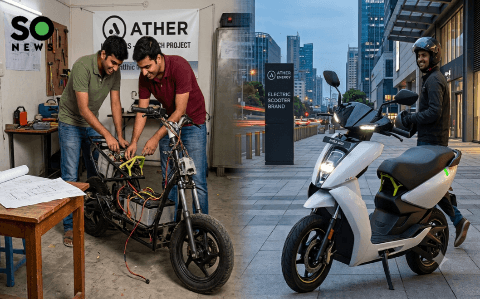
Ather Energy’s journey is one of India’s most notable electric vehicle success stories. What began as an idea between two IIT Madras graduates eventually became a publicly listed company competing with some of the country’s biggest two-wheeler manufacturers.
Founded in 2013 by Tarun Mehta and Swapnil Jain, Ather took a different approach to India’s emerging electric scooter market. Instead of focusing only on affordability, the company concentrated on technology, performance, design and the overall ownership experience.
Over the years, Ather moved from developing its first scooter to building charging infrastructure, manufacturing facilities, retail centres and a wider product portfolio. The launch of the family-focused Ather Rizta further expanded its reach beyond its original premium customer base.
Today, Ather’s journey represents how an Indian startup can build an automotive technology company from the ground up.
From IIT Madras to Ather Energy
The Ather story began at IIT Madras, where Tarun Mehta and Swapnil Jain started exploring electric vehicle technology.
Their early work focused on batteries and electric mobility. Rather than limiting themselves to developing individual EV components, the founders decided to build a complete electric scooter.
That decision led to the creation of Ather Energy in 2013.
At the time, India’s electric two-wheeler market was still in its early stages. Electric scooters were commonly viewed as basic alternatives to petrol-powered vehicles, with limited performance and technology.
Ather wanted to change that perception.
The founders believed an electric scooter could offer not only zero-emission mobility but also strong performance, modern design and connected technology.
Building an Electric Scooter From Scratch
Ather did not simply take an existing petrol scooter and replace its engine with an electric powertrain.
The company worked on its own vehicle platform and technology.
This approach eventually resulted in the Ather 450, which became the foundation of the company’s product strategy.
The scooter combined electric performance with features that were relatively uncommon in India’s two-wheeler market at the time. A touchscreen dashboard, connected features and software updates helped position the vehicle more like a technology product than a conventional scooter.
This became an important part of Ather’s identity.
The company was not simply selling an electric vehicle. It was trying to create a complete digital experience around the vehicle.
The Ather 450 Changes the Game
Ather began delivering its first scooters to customers in 2018.
The company also opened its first Ather Space in Bengaluru, giving customers a physical location to experience the product.
But Ather understood that electric mobility had another major challenge: charging.
Instead of waiting for charging infrastructure to develop around its products, the company started building its own network.
The Ather Grid charging network became an important part of the company’s ecosystem.
This resulted in a broader strategy:
Electric scooter + software + charging + service + retail experience.
That ecosystem helped Ather differentiate itself from many early EV manufacturers.
Why Ather Chose the Premium EV Market
Ather’s early strategy was not based on becoming the cheapest electric scooter manufacturer.
The company focused on building a premium product with better design, performance and technology.
It was a risky decision.
Electric mobility was still unfamiliar to many Indian consumers, and asking customers to pay a premium for an electric scooter required the company to convince them that the additional technology and experience were worth the price.
Ather gradually built a reputation around that proposition.
Instead of presenting electric scooters simply as cheaper alternatives to petrol vehicles, the company positioned them as modern, connected and desirable products.
Building More Than a Scooter
Ather’s growth was not limited to its vehicles.
The company continued improving the 450 platform while expanding its charging network, retail presence and manufacturing capabilities.
Its journey can broadly be divided into three stages.
2013–2018 was focused largely on developing the Ather 450 platform.
2018–2022 involved building operations and the wider EV ecosystem.
From 2022 onward, the company entered a phase of broader product and market expansion.
This progression was important because scaling an EV business requires much more than producing vehicles.
A company needs manufacturing capacity, charging infrastructure, service support, technology and customer access.
Ather invested in each of these areas.
The Rizta Opens a Bigger Market
One of the biggest changes in Ather’s growth strategy came in 2024 with the launch of the Ather Rizta.
Unlike the performance-oriented 450 series, Rizta was designed around practicality and family use.
The product helped Ather reach consumers who may not have been looking specifically for a sporty or premium electric scooter.
The move expanded Ather’s potential customer base.
The strategy was reflected in the company’s sales performance. In FY25, Ather sold 155,394 electric two-wheelers, compared with 109,577 units in FY24.
Revenue from operations also increased from around ₹1,754 crore in FY24 to approximately ₹2,255 crore in FY25.
The Rizta therefore became an important part of Ather’s transition from a relatively niche premium EV brand toward a broader electric two-wheeler company.
Expanding Across India
Product expansion was accompanied by a major retail expansion.
Ather’s Experience Centre network increased from 211 centres at the end of FY24 to 375 by the end of FY25.
These centres became an important part of the company’s customer strategy.
For a technology-led automotive brand, physical interaction remains important. Customers want to see the scooter, take a test ride, understand charging requirements and have access to service support.
Ather therefore continued investing in its offline presence alongside its digital ecosystem.
The company also expanded beyond India, with its network reaching markets including Nepal and Sri Lanka.
Building Manufacturing Capacity
Scaling an automotive business requires significant manufacturing infrastructure.
Ather established manufacturing operations in Hosur, Tamil Nadu, and continued increasing its production capabilities as demand grew.
The company later opened a second Hosur factory with an annual production capacity of around 4.2 lakh vehicles.
This expansion marked an important transition for Ather.
The company was no longer operating primarily as an EV startup focused on product development. It was building the manufacturing infrastructure required to operate at automotive scale.
Manufacturing also became increasingly important as the company expanded its product range and targeted a larger customer base.
Competing With India’s Biggest Two-Wheeler Players
Ather entered a market that was becoming increasingly competitive.
The company faced other electric vehicle manufacturers such as Ola Electric while also competing with established automotive companies including TVS Motor and Bajaj Auto.
These companies brought significant manufacturing experience, distribution networks and established brands to the EV market.
Ather’s response was to focus on its technology and product ecosystem.
Software, connected features, charging infrastructure, product design and customer experience became important elements of its differentiation.
The company gradually moved from being a small EV challenger to becoming one of India’s significant electric two-wheeler manufacturers.
The IPO: From Startup to Public Company
Ather reached another major milestone in 2025 when it entered the public markets.
The company’s IPO raised approximately ₹2,981 crore, including a fresh issue of around ₹2,626 crore.
Ather shares were listed on the NSE and BSE on May 6, 2025.
The listing represented a major transformation for a company that had started as an IIT Madras project more than a decade earlier.
The capital raised through the public offering also provided resources for areas such as manufacturing, research and development, marketing and future expansion.
The IPO effectively marked Ather’s transition from a venture-backed startup into a publicly listed automotive company.
The Numbers Behind Ather’s Growth
Ather’s transformation becomes clearer when its growth is viewed through its numbers.
In FY24, the company recorded approximately ₹1,754 crore in revenue from operations.
In FY25, revenue increased to approximately ₹2,255 crore.
Electric two-wheeler sales reached 155,394 units in FY25, compared with 109,577 units in the previous financial year.
The company also expanded its Experience Centre network to 375 locations by the end of FY25.
By 2025, cumulative scooter sales had crossed 400,000 units.
These figures show how Ather progressed from developing its first electric scooter to operating a much larger automotive ecosystem.
What Made Ather Energy Successful?
Ather’s success was not built around a single product or feature.
It came from several decisions working together.
1. Technology-First Approach
Ather treated software, connected features and vehicle technology as central parts of the product.
2. Strong Product Design
The company focused on creating scooters that looked and felt different from traditional low-cost electric vehicles.
3. Charging Ecosystem
Ather Grid helped the company address one of the biggest concerns surrounding electric vehicle adoption.
4. In-House Manufacturing
Investing in its own manufacturing capabilities gave Ather greater control over production as it scaled.
5. Physical Customer Experience
Ather Experience Centres gave customers an opportunity to see, test and understand its products before making a purchase.
6. Product Expansion
The 450 series helped establish Ather’s identity, while Rizta opened the brand to a wider family-oriented market.
Together, these elements created an ecosystem rather than simply a scooter business.
Ather’s Biggest Lesson: Build the Ecosystem
One of the strongest lessons from Ather’s journey is that selling an electric vehicle is only one part of building an EV company.
The company needed to address multiple challenges simultaneously.
Customers needed reliable vehicles.
They needed charging options.
They needed service and support.
They needed places where they could experience the product.
And the company needed manufacturing capacity to deliver vehicles at scale.
Ather gradually built each of these pieces.
This ecosystem-led approach became one of the defining characteristics of the brand.
From a Small Startup to a Public Company
Ather’s journey also demonstrates the importance of patience in hardware and automotive businesses.
The company was founded in 2013, but it took several years of research, product development and testing before its first scooters reached customers.
The company then spent years building manufacturing, charging infrastructure and retail operations.
Only after developing this foundation did Ather move toward mass-market expansion.
The launch of Rizta showed another important shift: a company can begin with a focused premium product and later expand toward a much larger market.
What’s Next for Ather Energy?
Ather’s next challenge is bigger than proving that customers want electric scooters.
The company now has to demonstrate that it can scale while improving its financial performance.
Increasing production, expanding its product portfolio and growing its market share will remain important priorities.
The company also needs to compete with established two-wheeler manufacturers that are investing heavily in electric mobility.
As India’s EV market becomes more competitive, Ather’s ability to maintain its technology advantage while reaching a broader range of customers will determine the next phase of its growth.
The Ather Energy Success Story
Ather Energy began with two IIT Madras graduates exploring the possibilities of electric mobility.
They could have focused on developing a battery or supplying technology to other manufacturers.
Instead, they decided to build their own electric scooter.
That decision led to the Ather 450.
Then came Ather Grid.
Then Experience Centres.
Then manufacturing facilities.
Then the Rizta.
And eventually, the stock market.
From an early-stage project in 2013 to a publicly listed electric two-wheeler company, Ather’s journey has been built around a simple idea: electric mobility should not only be sustainable, but also technologically advanced and desirable.
The company has shown that an Indian startup can build more than an electric scooter. It can build the technology, infrastructure, manufacturing and customer ecosystem around an entirely new category of mobility.
Ather’s success story is ultimately the story of two engineers who started with an idea at IIT Madras and spent more than a decade turning that idea into an Indian EV brand.