Startup Originals Team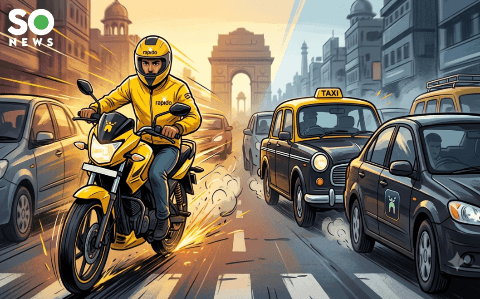
From a simple bike-taxi idea in Bengaluru to a major multi-modal mobility platform, Rapido has transformed the way millions of Indians think about short-distance travel.
India’s urban mobility problem has never been simply about finding a cab.
For millions of commuters, the bigger challenge is getting through crowded roads quickly and affordably.
A five-kilometre journey can become a frustrating experience when cars are stuck in traffic, public transport is crowded and traditional cabs are too expensive for a short trip.
In 2015, three entrepreneurs saw an opportunity in an everyday Indian solution: the motorcycle.
They were Aravind Sanka, Pavan Guntupalli and Rishikesh S.R., the founders of Rapido.
Their idea was straightforward.
What if people could book a motorcycle through an app and use it to travel through traffic faster and at a lower cost?
That idea became Rapido.
What started as a bike-taxi startup has since evolved into a multi-modal mobility company offering bike taxis, autos and cabs, while also expanding into delivery and other services.
The Problem Rapido Wanted to Solve
India’s cities have a unique transportation challenge.
Traffic congestion makes short-distance travel particularly difficult.
A car may be comfortable, but it can be inefficient in heavy traffic.
Public transport can be economical, but it does not always provide convenient door-to-door connectivity.
Rapido saw motorcycles as a potential solution.
Two-wheelers could move through congested roads more easily while offering a relatively affordable option for commuters.
The startup therefore built a technology platform connecting passengers with motorcycle riders, whom it calls Captains.
Instead of owning a traditional fleet, Rapido created a marketplace connecting riders and customers through its app.
Starting With Two Wheels
Rapido began by focusing almost entirely on bike taxis.
That gave the company a clear identity in India’s ride-hailing market.
While established players such as Ola and Uber were heavily associated with cars, Rapido focused on a different part of the market: short-distance, affordable urban mobility.
The company positioned bike taxis as a practical answer to India’s traffic problem.
Its own website describes bike taxis as a way to navigate peak-hour traffic quickly while keeping rides economical.
The model also created an opportunity for motorcycle owners to earn through the platform.
This created the basic two-sided marketplace:
Passengers needed affordable rides → Captains needed earning opportunities → Rapido connected both sides.
The Road Wasn’t Easy
Building a transportation company in India comes with challenges that go beyond technology.
Mobility businesses operate within state-specific transport regulations, and bike taxis have faced regulatory uncertainty in several markets.
Rapido therefore had to navigate questions surrounding permits, safety, insurance and the legal framework governing motorcycle taxis.
Instead of abandoning the category, the company continued developing its platform and expanding where regulations allowed.
That persistence became an important part of its journey.
Why Bike Taxis Became Rapido’s Competitive Advantage
Rapido’s biggest advantage was that it focused on a problem that large ride-hailing companies did not initially solve as directly.
For short journeys, a bike could be:
Faster in traffic.
Cheaper than a cab.
Easier to deploy in crowded cities.
That combination helped Rapido build a strong position in the bike-taxi segment.
According to a 2025 interview cited by Inc42, Rapido’s CEO said the company had about 70% of India’s bike-taxi market.
The company had found its niche.
But Rapido wasn’t satisfied with remaining a bike-taxi company.
From Bike Taxis to Autos
The next major step was expanding into auto-rickshaws.
Rapido entered the three-wheeler segment and began offering customers another affordable transportation option.
This was strategically important.
A passenger might prefer a bike for one journey but need an auto for another.
By offering both, Rapido could increase the number of transportation needs it could serve.
The company was slowly changing from a bike-taxi platform into a mobility platform.
Then Came the Cabs
Rapido made another major expansion in 2023 when it entered the four-wheeler cab market.
This put the startup into direct competition with much larger ride-hailing companies, including Ola and Uber.
The move changed Rapido’s position in the market.
It was no longer competing only in a niche category.
It was now attempting to become a complete urban mobility platform.
The journey had evolved:
Bike taxis → Autos → Cabs
And the strategy was simple: give customers multiple ways to travel through one platform.
A Different Business Model
Rapido also experimented with a different approach to driver economics.
Its bike-taxi business primarily operates on a commission model, while its auto and cab businesses use subscription-based arrangements.
Under the subscription model, drivers pay a fee to access customers through the platform instead of giving the company a percentage of every ride.
That model became increasingly important as Rapido expanded beyond bikes.
In FY25, Rapido’s subscription revenue jumped from ₹19 crore to ₹275 crore, reflecting the rapid expansion of its three- and four-wheeler businesses.
This gave the company another source of revenue beyond traditional ride commissions.
Taking on India’s Mobility Giants
For years, India’s ride-hailing market was dominated by established companies.
Rapido initially looked like a smaller specialist competing on two-wheelers.
But its strategy gradually changed the competitive landscape.
Rather than trying to immediately replicate the car-heavy model of traditional ride-hailing companies, Rapido built its business around India’s actual transportation behaviour.
It focused on affordability, traffic efficiency and a large Captain network.
Then it expanded into the same categories as its larger competitors.
According to Inc42, Rapido’s CEO claimed in 2025 that the company had approximately 40% share of India’s auto market and 22% of the cab market, alongside its leading position in bike taxis.
These figures show how dramatically the company had expanded from its original niche.
The Financial Turning Point
Rapido’s growth eventually began showing up in its financial performance.
In FY25, operating revenue increased 44% to ₹934.4 crore, compared with ₹648.1 crore in FY24.
At the same time, its net loss declined to approximately ₹258 crore, compared with ₹370.7 crore in the previous year.
Its EBITDA loss also fell sharply, from ₹409 crore to ₹104 crore.
This was an important turning point.
Rapido was growing while simultaneously reducing its losses.
The company also crossed the ₹1,000 crore total-income mark in FY25 when other income was included.
For a startup competing in an expensive and highly competitive industry, improving operating leverage was a significant achievement.
Rapido Was No Longer Just a Bike-Taxi Startup
The company continued expanding beyond transportation.
Rapido entered hyperlocal delivery and launched Ownly, its food-delivery business, in Bengaluru.
It has also explored parcel delivery and other mobility-related services.
This reflects a broader strategy:
Use the existing customer and Captain network to build additional businesses around local transportation and delivery.
The company incorporated subsidiaries for food delivery, financial services and vehicle-pooling initiatives as it expanded into adjacent categories.
That means Rapido’s long-term ambition extends beyond simply moving people.
It wants to build a broader local mobility and delivery ecosystem.
The Funding That Helped Rapido Scale
Rapido attracted major investors as its business expanded.
Its investors have included Swiggy, WestBridge Capital, TVS Motor Company, Shell Ventures, Nexus Venture Partners, Prosus and Accel.
The company entered the unicorn club during its 2024 funding journey, and its subsequent growth pushed the business into a much larger scale.
The funding gave Rapido the resources needed to expand its network, technology and services while competing with heavily funded mobility companies.
But money alone did not create the company’s success.
The critical advantage was its ability to understand India’s local transportation market.
The Rapido Formula
Rapido’s growth can be understood through a simple formula:
Affordable rides + large Captain network + local market understanding + multiple vehicle categories.
The company didn’t try to force Indian commuters into a single transportation model.
Instead, it added options.
Need to get somewhere quickly?
Bike taxi.
Need more space?
Auto.
Travelling with family or luggage?
Cab.
This multi-modal approach allowed Rapido to increase the number of journeys it could serve.
Why Rapido Challenged Ola and Uber
Rapido’s challenge to India’s mobility giants wasn’t based on having the biggest fleet.
It was based on designing a model specifically for India’s market.
Traffic congestion, price sensitivity and short-distance journeys created a natural opportunity for two-wheelers.
Rapido started there.
Then it expanded.
That gave the company an unusual competitive path:
Start with the segment others underestimated → dominate the niche → expand into adjacent categories.
This is one of the biggest lessons from Rapido’s journey.
Instead of attacking the largest market immediately, the startup first established itself where its product had a natural advantage.
The Startup’s Biggest Strength: Local Understanding
Global ride-hailing companies can bring technology and capital into India.
But Indian mobility has its own characteristics.
Different cities have different traffic patterns.
Customers have different price expectations.
Auto-rickshaws and motorcycles play a much larger role in daily transportation than in many Western markets.
Rapido built its product around those realities.
That local-first approach helped it move from a niche bike-taxi company into a broader mobility competitor.
A New Chapter for Rapido
Rapido’s latest phase is about scale and sustainability.
Its improving financial performance shows that the company is moving toward a more disciplined growth model.
At the same time, its expansion into autos, cabs and delivery creates new opportunities—and new challenges.
Each category has different economics, regulatory requirements and competitive pressures.
Rapido must therefore prove that it can maintain its cost advantage while building a sustainable multi-modal platform.
The company also continues to operate in a highly competitive market where established players have significant resources.
What’s Next for Rapido?
Rapido’s future will likely depend on how effectively it can expand its mobility ecosystem while improving profitability.
Its focus is no longer simply on increasing bike-taxi rides.
The bigger opportunity is building a platform where customers can access multiple forms of transportation and local delivery services.
Regulatory developments will also remain important. Most recently, Rapido received a five-year cab-service licence from Karnataka, valid through August 2031, providing a clearer regulatory framework for its cab operations in the state.
The company will also need to manage the complexity that comes with operating across bikes, autos, cabs and delivery services.
The Rapido Success Story
Rapido’s story began with a simple observation:
In India’s traffic-filled cities, two wheels can sometimes solve a problem that four wheels cannot.
Three founders turned that observation into a bike-taxi platform.
The company faced regulatory uncertainty, intense competition and the challenges of building a two-sided marketplace.
But instead of giving up when the market became difficult, Rapido expanded.
It moved from bikes to autos.
From autos to cabs.
And from mobility into delivery and other adjacent services.
The result is a company that is no longer viewed simply as a bike-taxi startup.
It has become a serious challenger in India’s mobility market.
Its FY25 operating revenue reached ₹934 crore, while its net loss narrowed by around 30% to ₹258 crore.
The journey demonstrates an important startup lesson:
A company doesn’t always have to defeat the biggest players by copying them.
Sometimes, it can win by understanding the market better.
Rapido started with India’s most common vehicle—the motorcycle—and built a business around the country’s biggest transportation challenges.
What began as a solution for beating traffic has evolved into a broader mobility platform.
Rapido’s biggest achievement isn’t simply that it made bike taxis popular. It showed that a startup built around India’s unique mobility needs could challenge some of the biggest names in the ride-hailing industry.