Startup Originals Team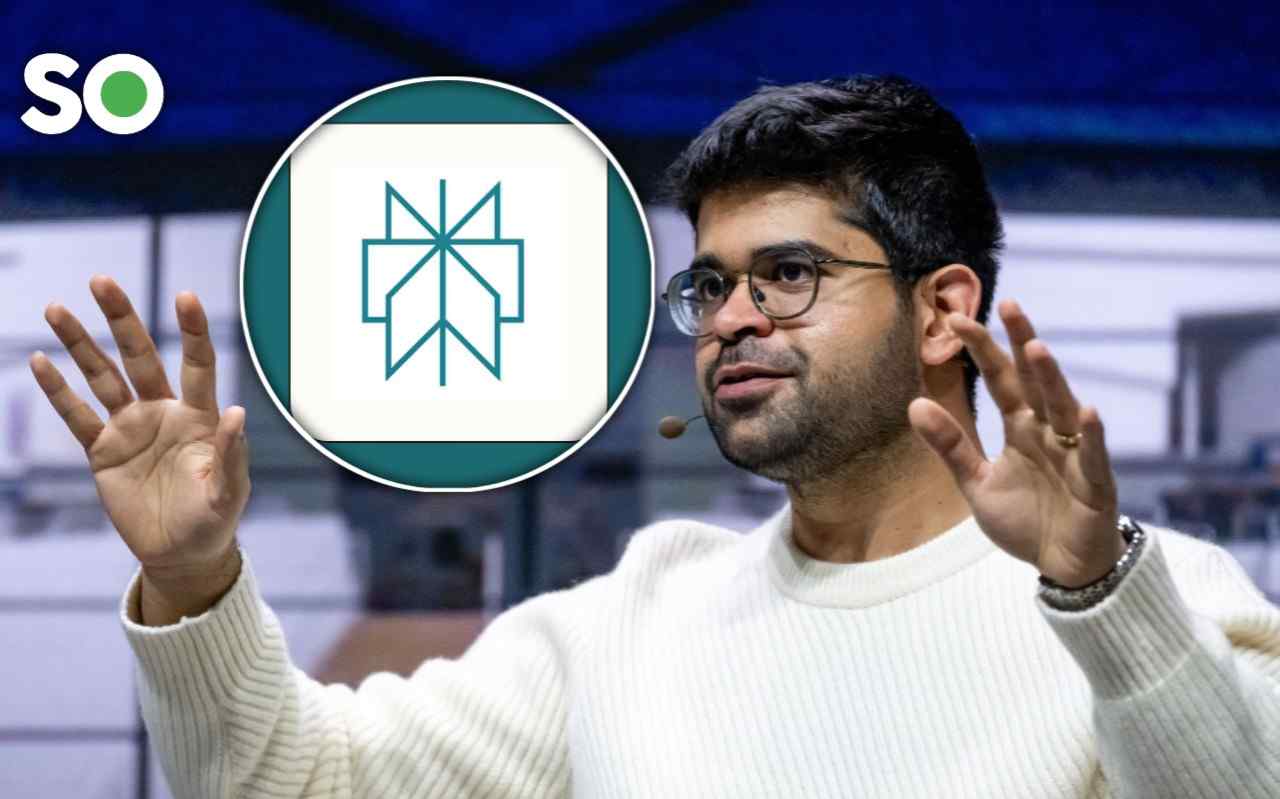
Perplexity AI is making serious noise in the global AI space. A strong rival to Sam Altman’s ChatGPT and Sundar Pichai’s Gemini, this San Francisco-based startup has redefined how people search for information online. And leading this disruption is Aravind Srinivas, a 31-year-old from Chennai who is now one of the most influential minds in AI and India’s youngest billionaire.
If you follow India’s biggest founder stories and the global AI race, this is one you need to know.
From a Middle-Class Home in Chennai to IIT Madras
Aravind Srinivas was born on June 7, 1994, in Chennai, Tamil Nadu, into a middle-class family. His mother used to point at the IIT Madras campus and tell him that was where he would study one day.
He delivered. He secured AIR 980 in IIT-JEE and went on to complete his BTech and MTech in Electrical Engineering from IIT Madras in 2017.
While at IIT, Srinivas taught himself Python, developed a strong interest in AI and machine learning, and began excelling in ML competitions. He also interned under Yoshua Bengio, one of the three “Godfathers of AI” and a Turing Award winner.
From Berkeley to the World’s Best AI Labs
In 2017, Srinivas moved to the United States to pursue a PhD at the University of California, Berkeley, where he focused on AI, reinforcement learning, and generative models.
During and after his PhD, he worked with three of the most important AI research organisations in the world. He spent time at DeepMind in London, where he was so dedicated he slept at the office because his rental was terrible but the office had a library. He worked at Google, contributing to projects like HaloNet and ResNet-RS. And he worked at OpenAI, where he contributed to DALL-E 2.
These experiences gave him deep expertise in large-scale AI systems and generative models. But they also showed him a gap that nobody was filling.
The Founding of Perplexity AI
In August 2022, just weeks before ChatGPT launched, Srinivas left OpenAI. Nobody knew the AI explosion was about to happen.
On December 7, 2022, exactly seven days after ChatGPT went live, Srinivas and his three co-founders launched Perplexity AI. The co-founders were Denis Yarats (CTO, ex-Meta AI), Johnny Ho (Chief Strategy Officer, ex-Quora), and Andy Konwinski (President, co-founder of Databricks).
Their pitch was simple. Google gives you ten links and makes you spend twenty minutes clicking through pages. Perplexity gives you the answer directly, with cited sources, in real time.
Srinivas called it an “answer engine” instead of a search engine. ChatGPT was a chatbot pulling from training data. Perplexity searched the web live and cited every source. That distinction made all the difference.
Growth at a Speed Rarely Seen in Tech
Perplexity’s rise has been one of the fastest value creation stories in AI history.
The valuation journey tells the story. Seed round in 2022 valued it at around $9 million. Series A in March 2023 took it to $150 million. Series B in January 2024 reached $520 million. By April 2024 it crossed $1 billion. SoftBank’s Vision Fund 2 invested $250 million in August 2024, tripling the valuation to $3 billion. A $500 million IVP-led round in December 2024 pushed it to $9 billion. By September 2025, Perplexity reached a $20 billion valuation. As of early 2026, the valuation crossed $22.6 billion.
Total funding raised: over $1.72 billion across 11 rounds from 56 investors including Jeff Bezos, NVIDIA, Accel, SoftBank, NEA, and Databricks. Even Google’s own Chief AI Scientist invested in Perplexity.
The company now has over 1,470 employees and processes more than 780 million queries per month, with over 30 million monthly active users. Its annual recurring revenue crossed $450 million in March 2026 and is targeting $656 million by end of 2026.
In August 2025, Perplexity made a $34.5 billion bid to buy Google’s Chrome browser. In December 2025, Cristiano Ronaldo took an undisclosed stake in the company and entered a global brand partnership.
Perplexity’s India Play
Perplexity is not just a Silicon Valley story. It has a strong India strategy.
The company partnered with Bharti Airtel to offer free Perplexity Pro access to users in India, bringing millions of Indian users into its ecosystem at zero customer acquisition cost.
In February 2026, Perplexity launched “Computer,” an AI agent that can handle tasks like shopping, email sorting, and social media summaries, moving beyond search into action. The company also introduced a “Model Council” feature that lets users compare outputs from multiple large language models like GPT-5.2 and Claude 4.6 simultaneously.
Perplexity Pro is available at $20 per month globally, with free access extended to students, US military veterans, and government employees.
What Should Startups and Founders Take Away?
For founders and investors watching the AI space, Perplexity’s story carries powerful lessons:
You don’t have to build your own LLM to win. Perplexity deliberately chose not to build a base model. Instead, it built the best product on top of existing models. That pragmatic decision saved hundreds of millions in training costs.
Pick a clear enemy. Perplexity didn’t call itself an AI tool. It called itself a better Google. That clarity shaped the product, the marketing, and every investor pitch.
Distribution beats paid acquisition. The Airtel and Samsung partnerships delivered millions of users faster than any ad campaign could have, at zero cost.
Indian founders are building at the frontier of global AI. Srinivas grew up in Chennai, studied at IIT Madras, and is now running the company that Google considers its most serious search competitor.
India’s AI founder stories are just getting started, and startuporiginals.in will keep tracking what this means for the ecosystem.
The Bottom Line
Aravind Srinivas grew up in the same city as Sundar Pichai. Both went to elite institutions. Both ended up in Silicon Valley. But while Pichai built Google, Srinivas built the company trying to replace it.
From a middle-class home in Chennai to leading a $20 billion AI company that processes 780 million queries a month, Srinivas proves that the biggest disruptions often come from people who were once on the inside looking out.
Perplexity is not just an AI search engine. It is a bet that the era of ten blue links is over. And so far, that bet is paying off.
Stay updated with India’s startup and founder stories. Explore more on Startup Originals: https://startuporiginals.in/