Startup Originals Team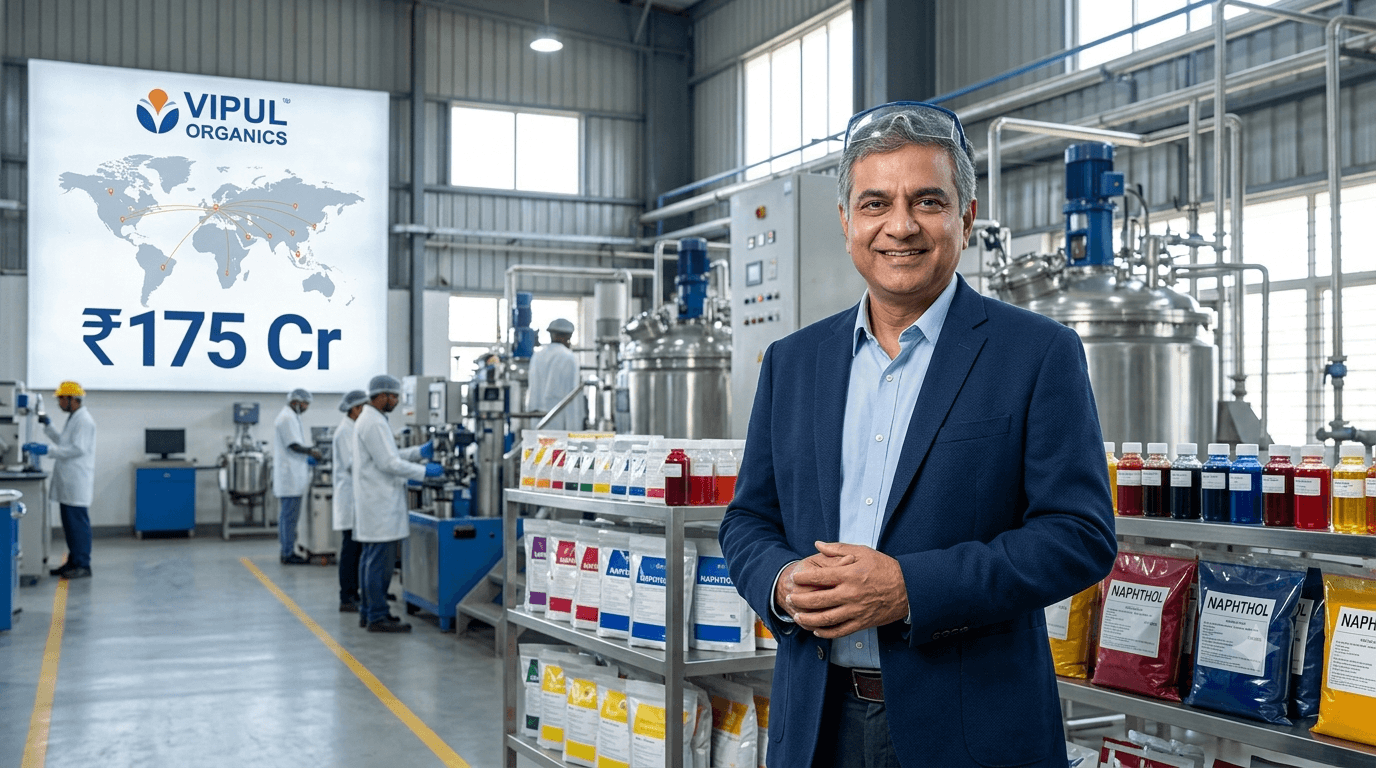
Some of the most interesting Indian business stories are not built around flashy launches or billion-dollar valuations. They are built slowly, through manufacturing, customer relationships and years of experience.
Vipul Organics is one such story. What began in 1968 as a small business dealing in naphthol, fast colour bases and dye intermediates has grown into a publicly listed colour chemistry company with customers across more than 45 countries.
The Mumbai-headquartered company now makes pigments, pigment dispersions, dyes, dye intermediates and other specialty colour products used across industries such as paints, plastics, textiles, printing inks, paper, cosmetics and food.
Its FY26 numbers show the scale of that transformation. Vipul Organics recorded standalone sales of ₹175.4 crore in FY26, compared with ₹162.8 crore in FY25. Net profit rose about 56% to ₹6.91–₹6.92 crore during the same period.
How Vipul Organics Started With a Small Chemical Business
The story of Vipul Organics goes back to 1968, when Pravinchandra B. Shah started a business dealing in naphthol, fast colour bases and dye intermediates.
These products may not be visible to consumers, but they are important building blocks for industries that manufacture coloured products. The company’s early business therefore focused on supplying industrial customers rather than selling directly to consumers.
In 1972, the business was formally established as Vipul Dye Chem. It later moved into manufacturing and expanded its capabilities beyond trading.
The company eventually established manufacturing operations around Maharashtra, creating the foundation for the larger business that followed.
The Second Generation Took the Business Into Pigments
A major change came in 1989, when Vipul P. Shah, son of the founder, joined the business after completing his chemical engineering degree.
His entry marked the beginning of the company’s expansion into new product categories. Vipul Organics moved beyond its earlier dye and intermediate operations and entered the pigments segment.
This helped transform the business from a relatively focused dye company into a broader supplier of colour solutions.
Vipul P. Shah is now the company’s Chairman and Managing Director, with decades of experience in the dyestuff and chemical industry.
The company also took an important step towards institutionalising the business when it went public and was listed on the Bombay Stock Exchange in 1995.
From Dyes to a Wider Colour Chemistry Portfolio
Over the years, Vipul Organics continued expanding its product portfolio.
Today, its offerings include pigment powders, pigment dispersions, textile dyes, paper dyes, leather dyes, naphthols, fast colour bases, fast colour salts and dye intermediates.
These products serve several industries, including paints and coatings, plastics, textiles, printing inks, cosmetics, paper and other manufacturing segments.
This diversification has been important to the company’s growth because it allows Vipul Organics to serve customers across multiple industrial applications instead of depending on one market alone.
Building a Business Beyond India
One of the biggest milestones in the company’s journey has been its international expansion.
Vipul Organics says it exports to more than 45 countries, giving the company a presence across international markets. Its products are supplied to customers in industries ranging from textiles and printing to paints, plastics and cosmetics.
The company has also worked on strengthening its manufacturing capabilities and supply chain so that it can compete with larger international producers.
Its export-led growth is significant because it shows how a relatively small Indian specialty chemicals company has built a customer base beyond its domestic market.
The Third Generation Joined the Family Business
The company’s growth story has now entered its third generation.
Mihir V. Shah, the son of Vipul P. Shah, joined the business in 2015. He has been involved in expanding the company’s domestic presence and opening new categories, including paper, agriculture and cosmetics.
He currently serves as Whole Time Director and Chief Financial Officer of Vipul Organics.
The involvement of three generations has allowed the company to retain its family-business roots while gradually adding new products, markets and manufacturing capabilities.
FY26 Shows the Business Has Entered a New Phase
The company’s latest financial performance provides another measure of how far it has come.
Vipul Organics reported standalone sales of ₹175.40 crore in FY26, up from ₹162.80 crore in FY25. That represents annual growth of about 7.74%.
The improvement was stronger at the profit level. Net profit increased to around ₹6.91 crore, compared with ₹4.43 crore in FY25, representing growth of about 56%.
The March 2026 quarter was also stronger. Sales reached ₹52.22 crore, up 18.44% year-on-year, while consolidated net profit increased 150.63% to ₹1.98 crore.
The numbers indicate that the company is not simply growing its revenue but is also working to improve profitability as it expands its business.
Sayakha Plant Could Increase Manufacturing Scale
A key part of Vipul Organics’ next phase is its greenfield manufacturing facility at Sayakha in Gujarat, one of India’s major chemical manufacturing hubs.
The company has described the facility as an important expansion project for its dyes and pigments business. Its FY25 annual report says the plant is intended to support the company’s long-term manufacturing ambitions and strengthen its position in global markets.
The planned expansion is particularly significant for pigments. Company management has said its existing pigment capacity was around 2,000 tonnes a year, with the Sayakha facility expected to take capacity to nearly 10,000 tonnes a year.
The larger scale is expected to help the company improve manufacturing efficiency and compete more effectively with larger global producers.
Vipul Organics Is Moving Beyond Traditional Dyes
The company is also trying to reduce its dependence on traditional colour products by entering new areas.
One such move is its development of an organic intermediate for the automobile industry. The company successfully executed the initial phase of a commercial order for the newly developed product, marking an entry into a higher-value industrial application.
Vipul Organics has also expanded into membrane technology through AdiMem, targeting the water-treatment market.
The move is significant because it takes the company beyond its traditional dyes and pigments business and into an area where specialised materials and technology can create new opportunities.
Sustainability Is Becoming Part of the Manufacturing Strategy
For chemical manufacturers, environmental performance has become increasingly important, particularly when serving international customers.
Vipul Organics has invested in manufacturing systems designed to reduce environmental impact. Its operations include a zero-liquid-discharge plant, while the company has highlighted its ability to recycle a large share of effluent water.
The company has also pursued certifications and standards relevant to sustainable textile and chemical manufacturing, including OEKO-TEX and ZDHC-related requirements.
These initiatives can help Indian specialty chemical manufacturers meet the increasingly strict environmental and compliance requirements of global customers.
Why Vipul Organics’ Story Matters
The Vipul Organics journey offers a different picture of Indian entrepreneurship.
It was not built through a single technology breakthrough or a rapid consumer expansion. Instead, the company spent decades building manufacturing expertise, developing products, entering new markets and maintaining relationships with industrial customers.
Its journey also highlights the potential of India’s family-owned manufacturing businesses to evolve across generations.
The first generation established the business. The second generation expanded it into pigments and took it to the public markets. The third generation is now working on new categories and strengthening its domestic and international presence.
Company Background
Vipul Organics is a Mumbai-headquartered specialty chemicals manufacturer that began its journey in 1968 under founder Pravinchandra B. Shah.
The company operates across pigments, pigment dispersions, dyes, naphthols, fast colour bases and salts, food colours and dye intermediates. Its products serve sectors such as paints, plastics, textiles, printing inks, paper, cosmetics and other industrial applications.
The company is publicly listed on the BSE and exports its products to more than 45 countries.
Its current leadership includes Chairman and Managing Director Vipul P. Shah and Whole Time Director and CFO Mihir V. Shah.
What the Future Could Look Like for Vipul Organics
The next phase of Vipul Organics will depend heavily on how successfully it scales its new manufacturing capacity and new product categories.
The Sayakha facility could significantly increase pigment production capacity, while the company’s work in automotive intermediates and membrane technology could open additional markets.
At the same time, the company can continue using its existing export network to take new products to international customers.
For a business that began with a small chemical trading operation nearly six decades ago, the focus is now shifting from simply expanding its product range to building greater manufacturing scale and competing more strongly in global specialty chemical markets.
Conclusion
The Vipul Organics success story is ultimately about patience, manufacturing expertise and generational entrepreneurship.
From a small naphthol business started by Pravinchandra B. Shah in 1968, the company has grown into a ₹175 crore-plus business with exports reaching more than 45 countries.
Its FY26 performance, new Sayakha manufacturing facility and entry into automotive intermediates and membrane technology show that the company is still evolving.
Vipul Organics may not have followed the typical startup path, but its journey demonstrates how an Indian family business can build a global manufacturing company by steadily investing in products, technology, capacity and markets over several decades.