Startup Originals Team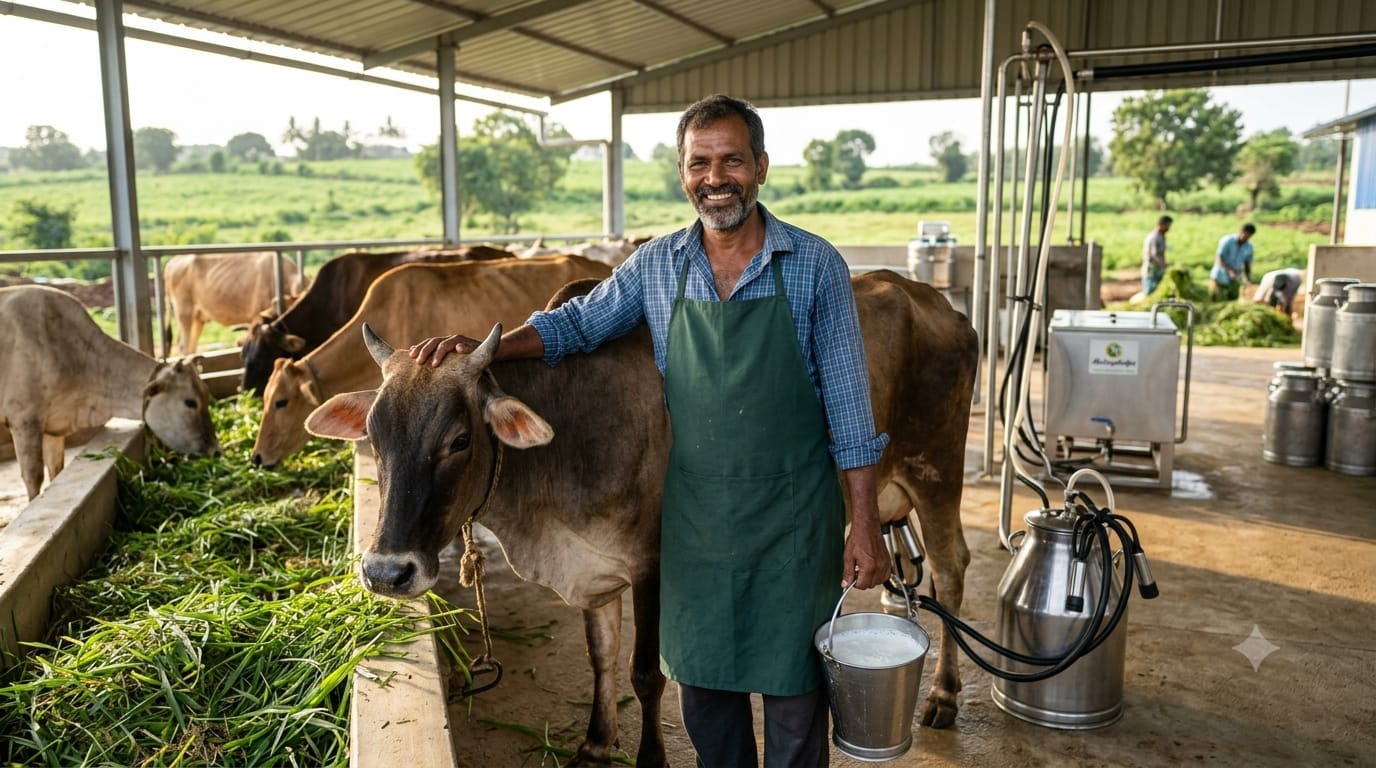
India’s agriculture sector has long faced a difficult challenge: how to make farming financially attractive enough for younger generations to choose it as a career.
For Shashi Kumar, Founder and CEO of Akshayakalpa, the answer was not simply to increase farm productivity. He wanted to change the economics of farming itself and make farmers think like entrepreneurs.
That idea became the foundation of Akshayakalpa, an organic dairy enterprise founded in 2010. Over the years, the company has developed a farmer-focused business model that combines dairy farming with sustainable agriculture and diversified farm activities.
According to the June 2026 profile referenced in the source material, Akshayakalpa has reached a reported ₹700 crore enterprise scale, generates around ₹60 crore in monthly business, and works with approximately 2,800 farmers across 2,800 villages.
The Problem That Inspired Akshayakalpa
Shashi Kumar grew up in a farming family and experienced the realities of agriculture closely.
His father was committed to farming but, like many parents, wanted his son to pursue education and find a conventional career away from agriculture. That experience made Kumar question why farming was increasingly being viewed as something young people should leave behind.
He believed the problem was not only how much farmers produced.
The bigger problem was whether farming could provide enough financial stability and opportunity to become a profession of choice.
That question eventually led Kumar to build a business around improving the economics of farming.
Why Dairy Became the Starting Point
When Akshayakalpa began in 2010, its objective was not simply to create another dairy brand.
The company chose dairy because milk can provide farmers with a regular source of income. For rural households, predictable cash flow can make a major difference in managing everyday expenses and investing in the farm.
Akshayakalpa gradually built a broader model around dairy farming, incorporating practices related to soil management, beekeeping, backyard poultry, banana cultivation, manure production and farm diversification.
The idea was to create stronger farm businesses rather than focus only on increasing milk output.
Turning Farmers Into Entrepreneurs
One of Akshayakalpa’s defining ideas is to treat farmers as entrepreneurs instead of simply suppliers.
The company works closely with farmers and provides support and training focused on areas such as farm productivity, animal health, soil quality and sustainable agricultural practices.
Its model aims to help farming families build viable businesses around their farms.
Akshayakalpa currently works with around 2,800 farmers, including approximately 1,200 women farmers. The average age of its farmer network is around 32, according to the source material.
That relatively young farmer base is important to the company’s broader objective of demonstrating that agriculture can be financially attractive to India’s younger generation.
The One-Farmer, One-Village Strategy
Akshayakalpa has developed an unusual approach to expanding its farmer network.
Instead of initially trying to work with many farmers in the same village, the company focuses on identifying one entrepreneurial farmer in a village.
That farmer can then become an example for others.
When neighbouring farmers see improvements in income, farm management and agricultural practices, the model can spread through the community.
The strategy is built around the belief that one successful farmer can demonstrate that agriculture can work as a serious business.
Building an Organic Dairy Brand
While farmer income sits at the centre of the business model, Akshayakalpa has also built a consumer-facing brand around organic and sustainable dairy production.
The company’s approach treats organic farming as a broader process involving soil health, animal welfare, biodiversity and sustainable farming practices.
Its product portfolio has expanded beyond milk to include products such as curd, paneer, ghee and butter.
The company has also focused on maintaining controlled processes around dairy production, including hygiene from milking through chilling.
This combination of farmer support and consumer-focused organic dairy products has allowed Akshayakalpa to connect rural production with an urban consumer market.
The Numbers Behind Akshayakalpa’s Growth
The scale of Akshayakalpa’s farmer network provides an important picture of how the company has expanded.
The June 2026 profile cited in the source material reports an enterprise scale of approximately ₹700 crore and monthly business of around ₹60 crore.
The company works with approximately 2,800 farmers across 2,800 villages, including around 1,200 women farmers.
The average age of the farmers in its network is approximately 32 years, supporting the company’s focus on making agriculture more attractive to younger people.
Akshayakalpa has also attracted institutional investment. In 2022, the company raised $15 million from investors including British International Investment and Rainmatter Foundation.
The Business Is Built Around Farmer Income
For Shashi Kumar, business growth is only one measure of Akshayakalpa’s success.
The larger objective is to create an agricultural model that provides farmers with sustainable and meaningful income.
According to the 2026 profile referenced in the source material, Akshayakalpa paid an average of approximately ₹1.28 lakh per month to each farming family during the financial year discussed.
Such income can have an impact beyond the farm itself. Higher and more predictable earnings can give families greater capacity to spend on education, housing, healthcare and farm improvements.
This is where Akshayakalpa’s model differs from a conventional dairy supply chain.
Farmers are not positioned simply as producers supplying raw material to a company. They are treated as an important part of the economic system the company is attempting to build.
From A Rural Challenge To A ₹700 Crore Business
Akshayakalpa’s journey shows how a business can emerge from an attempt to solve a structural problem in agriculture.
Rather than treating farmers as the final link in a supply chain, the company has made farmer economics central to its business model.
Its journey from a venture founded in 2010 to a business working with thousands of farmers demonstrates the commercial potential of combining sustainability with a strong farmer-focused model.
The company’s philosophy has also emphasised sustainable growth and operational fundamentals rather than simply spending more money to accelerate expansion.
For Akshayakalpa, the long-term question is therefore not only how quickly the company can grow, but whether its model can continue creating stronger farm businesses as it expands.
What Makes Akshayakalpa’s Model Different?
The company’s approach brings together three connected elements.
The first is farmer entrepreneurship. Akshayakalpa aims to help farmers operate their farms as businesses rather than treating agriculture only as a traditional occupation.
The second is organic and sustainable production. The company connects dairy production with soil health, animal welfare and other agricultural practices.
The third is consumer demand. By building a branded organic dairy business, Akshayakalpa creates a market for the products produced through its farmer network.
Together, these elements form a model in which the farmer, the supply chain and the consumer business are connected.
What’s Next For Akshayakalpa?
Akshayakalpa’s next challenge is to expand its farmer network while maintaining the quality and economics of its existing model.
The company will need to continue strengthening its organic dairy business while demonstrating that its farmer-first approach can work across a larger geographic footprint.
Its broader ambition, however, extends beyond selling milk and dairy products.
Shashi Kumar’s original question was about making farming attractive to the next generation. Akshayakalpa’s growth suggests that the answer may lie in treating farmers not merely as agricultural workers, but as entrepreneurs building businesses of their own.
Conclusion
Akshayakalpa’s journey is more than the growth story of an organic dairy company.
Founded in 2010, the company has built a business around a simple but ambitious idea: make farming financially attractive and farmers economically stronger.
With a reported ₹700 crore enterprise scale, around 2,800 farmers, 1,200 women farmers and a growing organic dairy portfolio, Akshayakalpa has created a model that connects commercial growth with rural livelihoods.
Its biggest success may ultimately not be the size of its dairy business. It may be its attempt to prove that farming can once again become a profession that India’s younger generation wants to choose.