Startup Originals Team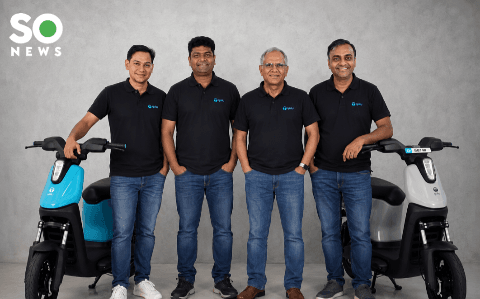
India’s cities are becoming increasingly crowded, while the demand for affordable, convenient and cleaner transportation continues to rise. Yulu entered this space with a simple idea: make short-distance urban travel easier without adding more pollution and congestion to already crowded roads.
What began in Bengaluru as a shared mobility startup has evolved into a major electric mobility company serving commuters, delivery workers and businesses.
Founded in 2017, Yulu has built its business around electric two-wheelers, technology-driven operations and battery-swapping infrastructure. Today, the company is operationally profitable and is preparing for another major phase of expansion after raising $93 million in fresh equity and debt funding.
The Founders Behind Yulu
Yulu was founded in 2017 by Amit Gupta, Naveen Dachuri, RK Misra and Hemant Gupta.
Amit Gupta had previously co-founded InMobi, giving him experience in building a technology company at scale. The founding team combined expertise in technology, operations, data and public policy to tackle India’s growing urban mobility problems.
The idea behind Yulu emerged from a problem that was becoming increasingly difficult to ignore: traffic congestion and deteriorating air quality in India’s major cities.
Rather than building another conventional ride-hailing platform, the founders focused on short-distance transportation and first- and last-mile connectivity.
Their goal was to create an affordable and sustainable alternative for everyday urban travel.
Why They Started Yulu
India’s transportation system has traditionally depended heavily on petrol and diesel-powered vehicles.
For short-distance journeys, however, many people do not necessarily need a full-sized motorcycle or car. They need something inexpensive, convenient and easy to access.
Yulu saw an opportunity in this gap.
The company began building a technology-enabled shared mobility platform where users could locate and unlock vehicles through an app and use them for short-distance journeys.
Its early model focused on dockless mobility, allowing customers to pick up a vehicle from designated locations and leave it at another appropriate location rather than depending on conventional rental stations.
The bigger vision was not simply to rent electric bikes.
It was to build an ecosystem around affordable, shared and sustainable urban mobility.
From Bicycles to Electric Vehicles
Yulu initially experimented with bicycles before moving deeper into electric mobility.
In 2019, the company launched its Yulu Miracle electric vehicle and began expanding its electric fleet. Around the same time, Yulu entered into a strategic partnership with Bajaj Auto, which invested $8 million in the company’s Series A round.
The Bajaj partnership became an important turning point.
Instead of relying only on an external vehicle supply chain, Yulu gained access to Bajaj’s engineering and manufacturing capabilities. The two companies began working together on the design and manufacturing of Yulu’s next-generation electric two-wheelers.
This helped Yulu move closer to building a mobility ecosystem designed specifically for Indian conditions.
Building More Than an EV Rental Company
Yulu’s ambitions gradually expanded beyond simply putting electric vehicles on city roads.
The company developed a technology-driven mobility platform and also entered the battery-swapping business.
In 2022, Yulu raised $82 million in Series B funding, led by Magna International, with existing investor Bajaj Auto also participating.
The company announced plans to use the capital to expand its EV fleet to more than 100,000 vehicles and build more than 500 battery charging and swapping stations.
The partnership with Magna also helped Yulu establish a battery-swapping business, allowing the company to build infrastructure around the batteries powering electric vehicles rather than treating the vehicle itself as the only product.
This was an important shift in Yulu’s strategy.
The company was no longer simply operating an electric-bike rental service. It was attempting to build infrastructure that could support a wider electric mobility ecosystem.
The Delivery Economy Changed Yulu’s Business
One of the biggest changes in Yulu’s journey came from India’s rapidly growing delivery economy.
As food delivery, e-commerce and quick commerce expanded, thousands of delivery workers needed affordable vehicles that could operate for long hours without the fuel costs associated with conventional motorcycles.
Yulu’s electric vehicles became increasingly useful for this market.
By 2023, delivery executives accounted for around 60% of Yulu’s fleet utilisation and revenue share, according to the company. More than 50,000 delivery workers had used Yulu’s services during FY23.
This helped Yulu move from being primarily a consumer mobility company toward becoming an important part of India’s last-mile delivery ecosystem.
Its vehicles were being used not only for commuting but also for making deliveries.
A New Wave of Growth
Yulu continued raising capital as demand for its electric mobility services increased.
In February 2024, the company raised another $19.25 million from existing investors Magna and Bajaj Auto.
Yulu said its revenue had increased nearly fivefold over the previous year, with the fresh capital intended to support expansion in vehicles, operating locations, products and technology.
The company also experimented with a franchise-led expansion model.
In 2024, Yulu launched in Indore through a city-based franchise partner, allowing the local partner to independently operate Yulu vehicles while receiving infrastructure and technology support from Yulu.
This model gave the company another route to expand without relying entirely on company-operated networks.
From Startup to a Profitable Mobility Business
Yulu’s latest numbers show how significantly its business has changed.
According to Reuters, Yulu’s revenue almost doubled to ₹237 crore in FY25, while its losses narrowed by 12% to around ₹126 crore.
More importantly, the company has been operationally profitable since April 2025, meaning it no longer needs equity funding to finance its day-to-day operations.
That marks a significant milestone for a startup operating in the capital-intensive electric mobility sector.
Instead of raising money simply to keep the business running, Yulu says its current funding requirement is primarily about expanding its fleet and entering new markets.
Yulu Raises $93 Million to Scale Its Next Chapter
On August 12, 2026, Yulu announced its latest and largest major funding round.
The company raised $93 million, comprising $63 million in equity and $30 million in debt.
The equity component was led by climate-focused investment firm GEF Capital Partners. Existing investors Bajaj Auto and Magna International did not participate in this round.
The fresh capital will allow Yulu to dramatically increase its fleet.
The company currently operates around 50,000 two-wheelers and plans to increase that number to 200,000 over the next two years.
It also plans to expand from 12 cities to 20 cities within the next 12 months, using a combination of company-operated and franchise models.
This represents a major shift in scale for the company.
Entering the Next-Generation Delivery Market
Yulu’s next phase is not limited to shared commuter mobility.
The company is entering intra-city logistics with a high-payload electric scooter designed for applications including e-commerce logistics, bike taxis and express parcel delivery.
Its existing fleet is largely made up of low-speed vehicles used for quick-commerce and food-delivery operations.
The new vehicle could help Yulu address a wider segment of India’s growing urban logistics market.
This strategy reflects how the company has evolved.
Yulu started by helping people move around cities.
It is now increasingly helping businesses and delivery workers move goods around cities.
The Road Ahead
Yulu expects its larger fleet and expanded operations to help it become monthly PAT-positive in the next calendar year.
The company is targeting annualised revenue of between ₹1,200 crore and ₹1,500 crore and plans to reach profitability before considering a potential public listing.
The immediate focus will be on increasing fleet utilisation, entering more cities and expanding its logistics business while maintaining operational profitability.
Lessons From Yulu’s Success Story
Yulu’s journey offers several lessons for India’s startup ecosystem:
- Solve a real problem: Yulu started with the everyday problems of congestion, pollution and expensive short-distance mobility.
- Adapt to changing markets: The company evolved from consumer mobility toward delivery and logistics as India’s digital economy expanded.
- Build strategic partnerships: Partnerships with companies such as Bajaj Auto and Magna helped Yulu strengthen its manufacturing, technology and battery ecosystem.
- Focus on unit economics: Becoming operationally profitable has allowed Yulu to shift its focus from survival to expansion.
- Think beyond the original product: Yulu expanded from shared electric vehicles into battery infrastructure and now urban logistics.
Conclusion
Yulu’s story is a reflection of how India’s startup ecosystem is evolving.
What began in 2017 as a Bengaluru-based attempt to solve urban transportation problems has grown into an electric mobility company serving commuters, delivery workers and businesses.
Its journey was not built overnight. Yulu moved through several stages—from bicycles and shared mobility to electric vehicles, battery swapping, delivery services and logistics.
Now, with $93 million in fresh funding, operational profitability and plans to scale its fleet from 50,000 to 200,000 vehicles, Yulu is entering its most ambitious phase yet.
The company’s next challenge will be to prove that electric mobility can scale profitably across India’s cities while becoming an important part of the country’s rapidly expanding delivery and logistics economy.
For Yulu, the journey from a small mobility experiment to a large-scale electric mobility platform is still far from over.