Startup Originals Team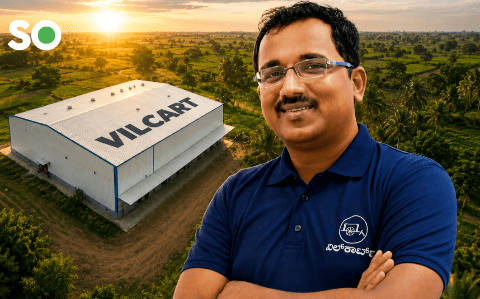
While India’s startup ecosystem has largely focused on serving urban consumers, Prasanna Kumar C saw an opportunity where few others were looking—India’s villages. Growing up in a farming family in Mandya, Karnataka, he witnessed firsthand the everyday struggles of rural kirana store owners. Instead of building another quick-commerce platform for cities, he founded VilCart, a startup dedicated to strengthening rural retail. Today, the company generates ₹1,176 crore in annual revenue, serves over 30,000 villages, and has become one of India’s largest rural commerce platforms.
A Childhood That Shaped an Entrepreneur
Prasanna Kumar C was raised in a farming family in Karnataka’s Mandya district and studied in Kannada medium during his early education.
After becoming a Chartered Accountant, he established his own CA practice. However, his entrepreneurial ambitions grew stronger as he observed a recurring problem affecting rural businesses.
Village kirana shop owners often had to spend an entire day travelling to nearby towns just to purchase inventory, losing valuable business time and increasing operating costs.
Prasanna believed technology and efficient supply chains could solve this challenge.
The Birth of VilCart
In 2018, he made a bold decision.
He shut down his Chartered Accountancy firm and launched VilCart.
The company’s mission was simple:
Help rural retailers restock faster, cheaper, and without travelling long distances.
Instead of focusing on consumers directly, VilCart built a technology-driven supply chain connecting manufacturers with village retailers.
Seeing Opportunity Beyond India’s Cities
Nearly 70% of India’s population lives in rural areas, yet most modern commerce companies concentrate on urban customers.
While quick-commerce companies expanded aggressively in metropolitan cities, VilCart chose a completely different path.
The company made village kirana stores the centre of its business model.
Rather than replacing local retailers, VilCart empowered them with better technology, inventory access, and logistics support.
How VilCart Works
VilCart connects:
- Manufacturers
- Consumer brands
- Farmer Producer Organisations (FPOs)
- Village kirana stores
Through the platform, retailers can:
- Place inventory orders digitally
- Manage stock
- Access billing systems
- Receive deliveries within 24–48 hours
This reduces travel costs, improves inventory availability, and helps shop owners focus on serving customers.
Building Rural Commerce at Scale
While companies such as Zepto, Blinkit, Swiggy Instamart, and Flipkart Minutes concentrated on urban markets, VilCart expanded across rural South India.
Today, the company serves:
- 30,000+ villages
- 1 lakh+ kirana stores
- More than 2 crore people
- Around 16% of South India’s rural population
Its operations currently span:
- Karnataka
- Tamil Nadu
- Andhra Pradesh
- Telangana
A ₹1,176 Crore Business
VilCart’s growth has been remarkable.
According to FY26 highlights, the company has achieved:
- ₹1,176 crore in annual revenue
- 80,000+ active billed kirana stores
- 1,600+ employees
- 24–48 hour delivery network
- Around 99% order fulfilment rate
These numbers demonstrate how rural-focused innovation can create a business at significant scale.
Building Its Own Brands
Beyond logistics, VilCart has expanded into private-label products.
The company owns 43 registered trademarks and develops affordable products using insights gathered from rural consumers.
Its private-label business has grown rapidly:
- Contribution increased from around 5% to 18% of total revenue
This strategy has helped improve profitability while offering better value to rural retailers.
Growing Efficiently
One of VilCart’s most remarkable achievements is its capital efficiency.
Despite raising only around $26 million in external funding, the company has built a business generating more than ₹1,176 crore in annual revenue.
The startup is now preparing for its Series B funding round, with plans to:
- Expand further across South India
- Strengthen its technology platform
- Scale private-label brands
- Target ₹1,500 crore in revenue during FY27
Lessons from Prasanna Kumar C’s Journey
Prasanna Kumar C’s entrepreneurial journey offers several valuable lessons:
- Some of the biggest business opportunities exist outside major cities.
- Technology can solve traditional rural challenges.
- Local retailers can become powerful partners instead of competitors.
- Capital efficiency often matters more than aggressive fundraising.
- Understanding underserved markets can create lasting competitive advantages.
Conclusion
From studying in Kannada medium and working as a Chartered Accountant to building a ₹1,176 crore rural commerce company, Prasanna Kumar C has shown that India’s next wave of startup growth lies beyond metropolitan cities. By empowering village kirana stores instead of replacing them, VilCart has built a scalable business that serves millions of people while strengthening rural economies. His journey proves that innovation is most powerful when it solves real problems for underserved communities.