Startup Originals Team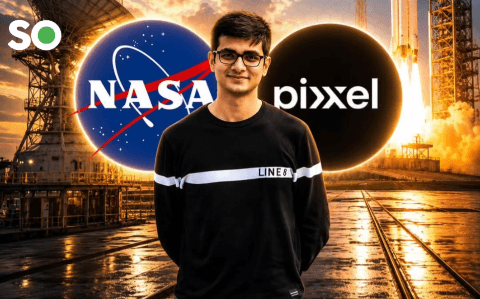
India’s space startup ecosystem has produced several remarkable entrepreneurs, but few journeys are as inspiring as that of Awais Ahmed. Growing up in the small village of Aldur in Chikkamagaluru, Karnataka, with limited access to technology, he transformed his childhood curiosity about space into Pixxel, one of India’s leading space-tech startups. Today, the company has raised nearly $95 million (around ₹900 crore) and has earned global recognition, including becoming the first Indian space startup to secure a contract with NASA.
A Childhood Inspired by Space
Awais Ahmed was born and raised in Aldur, a village in Karnataka’s Chikkamagaluru district.
Growing up, he had:
- No internet access
- No smartphone
- Limited exposure to modern technology
Instead, his fascination with space came from science encyclopaedias that his father regularly brought home. Those books introduced him to astronomy, satellites, and space exploration, planting the seeds for a lifelong dream.
Building Technical Skills at BITS Pilani
Awais later pursued Mathematics at Birla Institute of Technology and Science Pilani (BITS Pilani).
During his college years, he actively participated in several high-profile engineering projects, including:
- Team Anant, a student satellite initiative supported by Indian Space Research Organisation (ISRO)
- Engineering Lead at Hyperloop India
- Representing India at the SpaceX Hyperloop Pod Competition
These experiences helped him develop practical expertise in aerospace engineering, satellite systems, and advanced technologies.
The Birth of Pixxel
In 2018, during the IBM Watson AI Challenge, Awais and his college friend Kshitij Khandelwal noticed a major limitation in existing satellite imagery.
Conventional satellites often lacked the level of detail needed for applications such as:
- Precision agriculture
- Environmental monitoring
- Resource management
Seeing this opportunity, the duo founded Pixxel in 2019, initially using money borrowed from Awais’s father to start the company.
Their mission was ambitious: build satellites capable of capturing Earth in far greater detail than traditional imaging systems.
Building Advanced Hyperspectral Satellites
Pixxel focuses on hyperspectral imaging, a technology that captures hundreds of light wavelengths beyond what ordinary satellite cameras can detect.
In 2025, the company launched its Firefly satellite constellation, capable of capturing more than 250 spectral bands.
This technology enables applications such as:
- Early crop disease detection
- Methane leak monitoring
- Pollution tracking
- Illegal mining detection
- Climate and environmental analysis
The detailed imagery helps governments, researchers, and businesses make better decisions using high-resolution Earth observation data.
Global Recognition
Pixxel has rapidly become one of the world’s leading space-tech startups.
Its achievements include:
- Raising $95 million (around ₹900 crore) in funding
- Backing from investors including Google, Lightspeed Venture Partners, and Radical Ventures
- Becoming the first Indian space startup to secure a NASA contract
- Signing a five-year agreement with the National Reconnaissance Office (NRO)
- Recognition in TIME’s Best Inventions 2023
- Named a World Economic Forum Technology Pioneer 2024
These milestones have positioned Pixxel among the fastest-growing commercial space companies globally.
Lessons from Awais Ahmed’s Journey
Awais Ahmed’s story demonstrates that innovation is not limited by geography or resources.
His journey highlights several important lessons:
- Curiosity can create extraordinary opportunities.
- Strong technical foundations matter.
- Real-world engineering experience builds confidence.
- Global businesses can begin with modest resources.
- Solving meaningful problems attracts global recognition.
From reading science books in a small village to building satellites used around the world, his journey reflects the power of perseverance and vision.
Conclusion
Awais Ahmed transformed a childhood fascination with space into Pixxel, one of India’s most successful space-tech startups. From borrowing money to launch the company to raising nearly ₹900 crore, deploying advanced hyperspectral satellites, and securing prestigious international partnerships, his journey showcases how determination, technical excellence, and innovation can create global impact. Today, Pixxel is not only helping industries better understand the Earth but also establishing India as a rising force in the global space technology ecosystem.