Startup Originals Team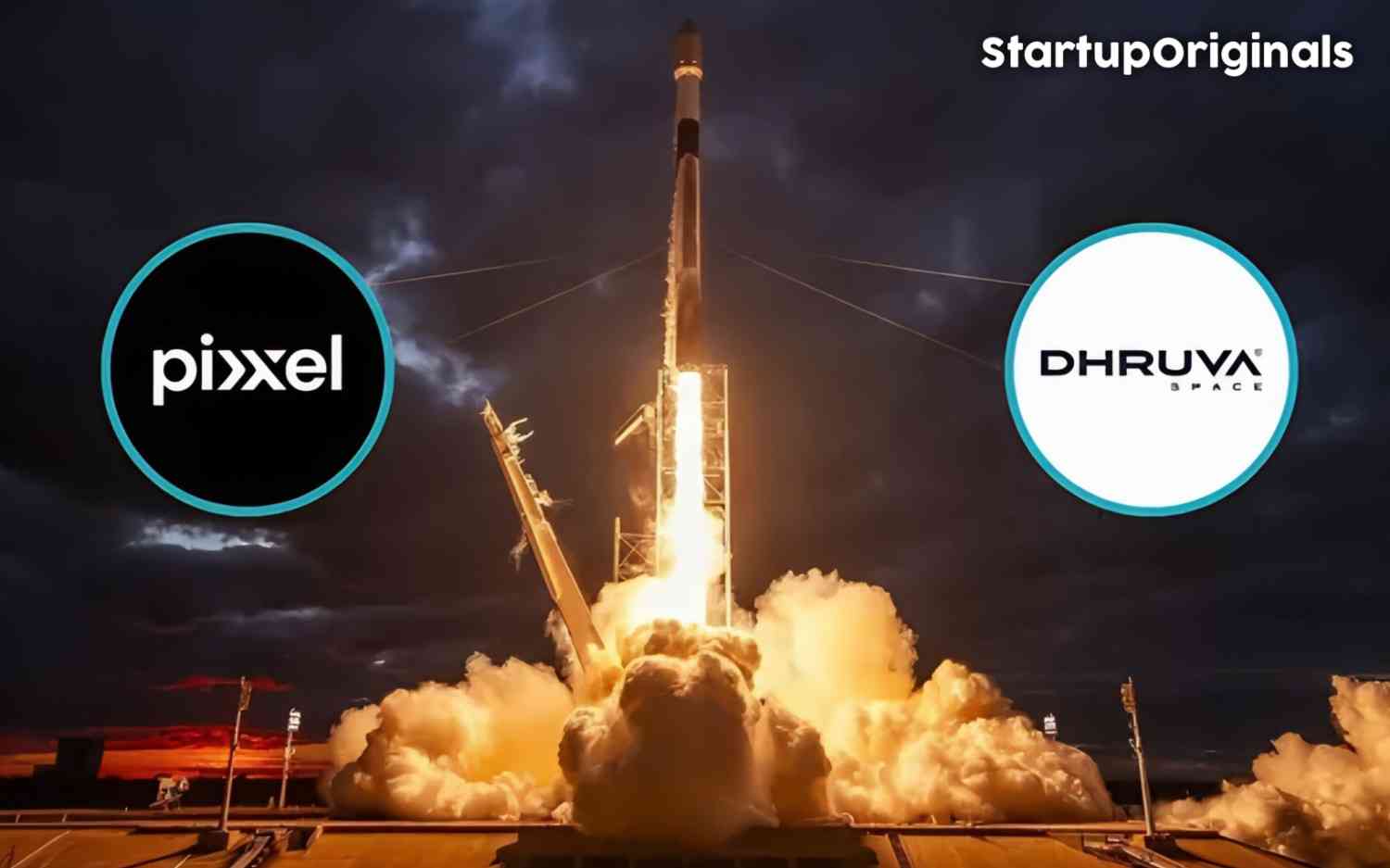
Two Indian startups, Pixxel and Dhruva Space, reached major milestones on August 27, 2025, launching their cutting-edge satellites aboard SpaceX’s Falcon 9 rocket from Cape Canaveral, Florida. This event showcased India’s growing capabilities and partnerships in the high-tech global space market, further strengthening ties with international collaborators and propelling private space innovation forward.
About Pixxel: Building a Hyperspectral Constellation
Based in Bengaluru, Pixxel specializes in advanced hyperspectral satellite imaging technologies. During the recent Falcon 9 mission, Pixxel launched three new Firefly satellites, bringing its current orbital fleet to six.
Pixxel’s Firefly satellites stand out for their ability to capture over 135 spectral bands at a five-meter ground resolution across a 40-kilometre swath. Such capability grants governments and industries nearly real-time, fine-grained insights across a range of applications, including climate monitoring, agriculture, environment, and resource management.
Pixxel plans to expand its fleet further with the upcoming “Honeybees” satellites. These next-generation satellites will extend coverage into more parts of the electromagnetic spectrum, enhancing both resolution and frequency of revisit, thus supporting sharper global analytics and predictive climate tools.
With $95 million raised from investors including giants like Google, Lightspeed, and Glade Brook Capital, Pixxel is well-funded to become a global leader in satellite-based earth observation.
Dhruva Space: India’s Commercial Leap with LEAP-1
Hyderabad-based Dhruva Space, founded in 2012, took its first major step into commercial space operations with the LEAP-1 mission. Hosted on its P-30 satellite platform, LEAP-1 carried two significant in-orbit demonstration payloads from Australian companies Akula Tech and Esper Sats.
Akula Tech provided Nexus-01, an advanced AI module for real-time geospatial data processing, demonstrating onboard analytics capabilities that shorten response times for critical applications. Esper Sats contributed a hyperspectral imager, underscoring the growing Indo-Australian partnership in space missions.
This mission also marks Dhruva Space’s transition from successful technology demonstrations aboard ISRO platforms to hosting and scaling international payloads for commercial clients. With $15 million in investment from backers like Indian Angel Network Alpha Fund and Blue Ashva Capital, Dhruva Space is poised to support cost-effective, global satellite operations.
Impact and Future Outlook:
The Falcon 9 launch by SpaceX featuring Indian payloads signals a strong shift in India’s role in the international space sector, amplifying opportunities for domestic startups and cross-border collaborations, especially with Australian partners. Pixxel continues to build toward a constellation of up to two dozen satellites by 2025, while Dhruva Space expands hosted commercial missions with advanced AI and imaging payloads.
As these ventures mature, they promise enhanced earth observation capabilities, faster emergency responses, smarter climate analytics, and strengthened global ties-heralding a landmark era for Indian innovation in space.